Baltimore Moves to Regulate Prediction Markets for Sports Betting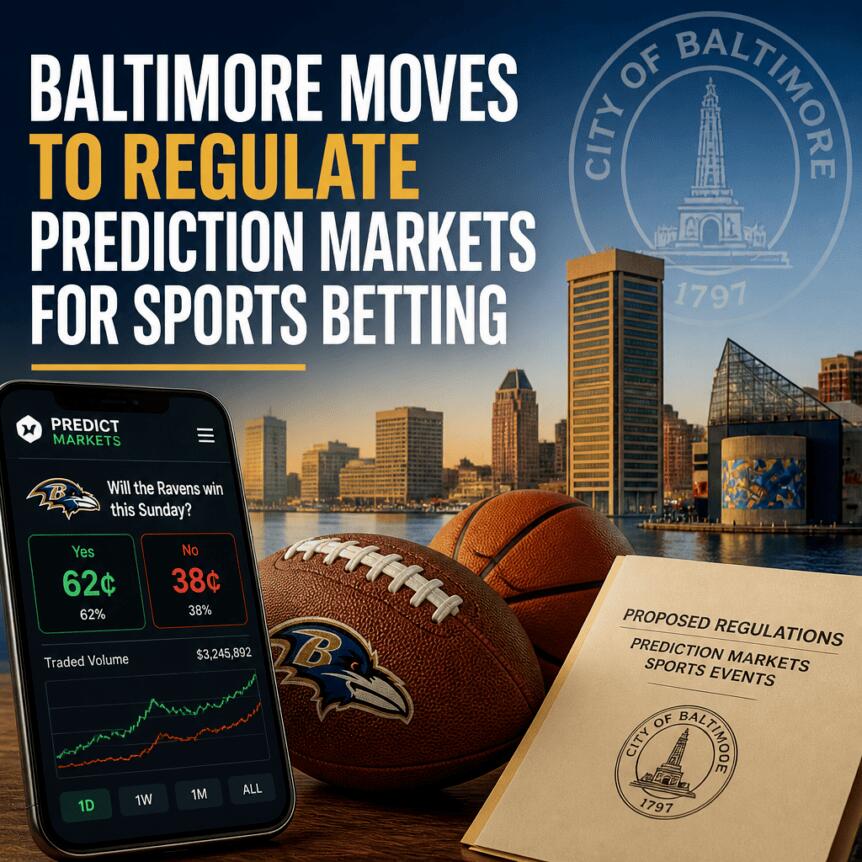
The City of Baltimore, led by Mayor Brendan Scott, has filed legal actions against two prediction-market platforms—Kalshi and Polymarket—arguing that both companies are effectively running sports-betting operations without the required licenses under Maryland law. The city’s notice, issued Thursday, also alleges that the firms misrepresented the legal status of their products to users.
According to a press release from Baltimore’s mayor’s office, the lawsuits contend that trades on event contracts should be treated as unlawful wagers under state gambling statutes, despite how each company characterizes the instruments. The complaints seek enforcement of consumer protection and gambling-related provisions, framing the dispute as a matter of whether the platforms can operate in Maryland when users are not told—and regulators do not agree—that the activity is legal.
Key takeaways
- Baltimore has sued Kalshi and Polymarket, asserting they run “illegal, unlicensed sports-betting” and mislead users about regulatory status.
- The city’s case centers on whether event contracts are actually wagers under Maryland law, disputing how both platforms describe the products.
- Kalshi’s complaint names multiple trading and brokerage partners, including Robinhood, Webull, and Coinbase, over marketing-related claims.
- The dispute adds to an ongoing U.S. federal-versus-state regulatory fight over prediction markets, with expectations of further appeals.
- Polymarket says city-specific enforcement conflicts with the federal framework for platforms operating under CFTC-registered exchange rules.
Baltimore targets “event contracts” as unlawful wagers
In Thursday’s notice, Baltimore’s mayor’s office said both companies operate what it describes as “illegal, unlicensed sports-betting platforms.” The city’s argument is not limited to licensing; it also alleges that the companies misled users about the legality and regulatory treatment of the products.
The core of the lawsuits is how the event contracts are classified. Baltimore argues that transactions conducted through prediction-market platforms are effectively betting arrangements that should be regulated as gambling under state law. The complaint challenges the platforms’ characterization of these instruments and argues that the trades function as wagers tied to real-world outcomes.
Mayor Brendan Scott said the companies are operating sportsbooks without licenses and suggested that simply rebranding the activity will not change what the city views as the underlying legal nature of the trades.
Kalshi case includes prominent distribution partners
One notable feature of Baltimore’s Kalshi-related complaint is the inclusion of well-known trading and brokerage firms as partners. The city’s filing lists Robinhood, Webull, and Coinbase among entities connected to the prediction-market platform.
Those companies were accused in the lawsuit of deceptive practices tied to marketing. Baltimore’s complaint alleges that promotional materials presented sports contracts in a way that suggested they could be “lawfully be purchased and traded in Maryland.” By naming these partners, the city is also broadening the enforcement target beyond the platform itself, implying that distribution and marketing conduct may be part of the alleged consumer harm.
For market participants, the inclusion of third-party partners raises the stakes of the dispute: if the litigation hinges on how contracts were marketed and interpreted by users, it could influence how other platforms structure compliance, disclosures, and listing terms across different jurisdictions.
Federal CFTC oversight remains the central fault line
Baltimore’s actions land in the middle of a wider regulatory dispute between federal and state authorities regarding prediction markets. Many experts expect these fights to escalate through appeals, potentially reaching the U.S. Supreme Court.
The disagreement reflects a long-running question: whether event contracts offered by prediction markets fall under the Commodity Futures Trading Commission’s (CFTC) regulatory authority. The CFTC, led by Chair Michael Selig, and companies have argued that event contracts on prediction markets meet the definition of “swaps” under federal oversight. State-level authorities, including Baltimore in this case, dispute that characterization and argue that local gambling laws can still apply.
This tension is not theoretical. Baltimore’s lawsuits explicitly frame the activity as illegal and unlicensed sports betting under Maryland law, while federal arguments emphasize that properly structured prediction-market trading is governed by federal rules rather than a patchwork of state requirements.
Polymarket pushes back on local enforcement
Polymarket responded to the lawsuits by arguing that Baltimore’s approach undermines the federal regulatory design for prediction markets. In a statement provided to Cointelegraph, a Polymarket spokesperson said city-specific action contradicts what they describe as the CFTC’s established framework.
The spokesperson added that courts have recognized prediction markets on CFTC-registered exchanges are governed by federal law rather than state-by-state enforcement. In other words, Polymarket’s position is that the legal classification—and the location of regulatory authority—should not change based on a city’s interpretation of gambling statutes.
The dispute matters for traders and users because a patchwork of enforcement could affect where and how prediction-market contracts are accessible, as well as how platforms handle geofencing, disclosures, and compliance processes across states and municipalities.
What comes next for Baltimore’s lawsuits
With both local action and federal oversight claims pointing in different directions, the most immediate question is how courts will treat the legal characterization of event contracts—particularly whether the transactions will be viewed as wagers under state gambling statutes or as instruments that belong within the CFTC’s federal regulatory scope. Readers should watch for how the cases progress through early rulings and whether higher courts are ultimately asked to settle the federal-versus-state divide.
This article was originally published as Baltimore Moves to Regulate Prediction Markets for Sports Betting on Crypto Breaking News – your trusted source for crypto news, Bitcoin news, and blockchain updates.
Source:
Baltimore Moves to Regulate Prediction Markets for Sports Betting

 Shoutbox
Justin Sun says Tron’s post-quantum... by Administrator
 Total Members: 344