Vitalik Buterin: Hegotá may be Ethereum’s final “normal” fork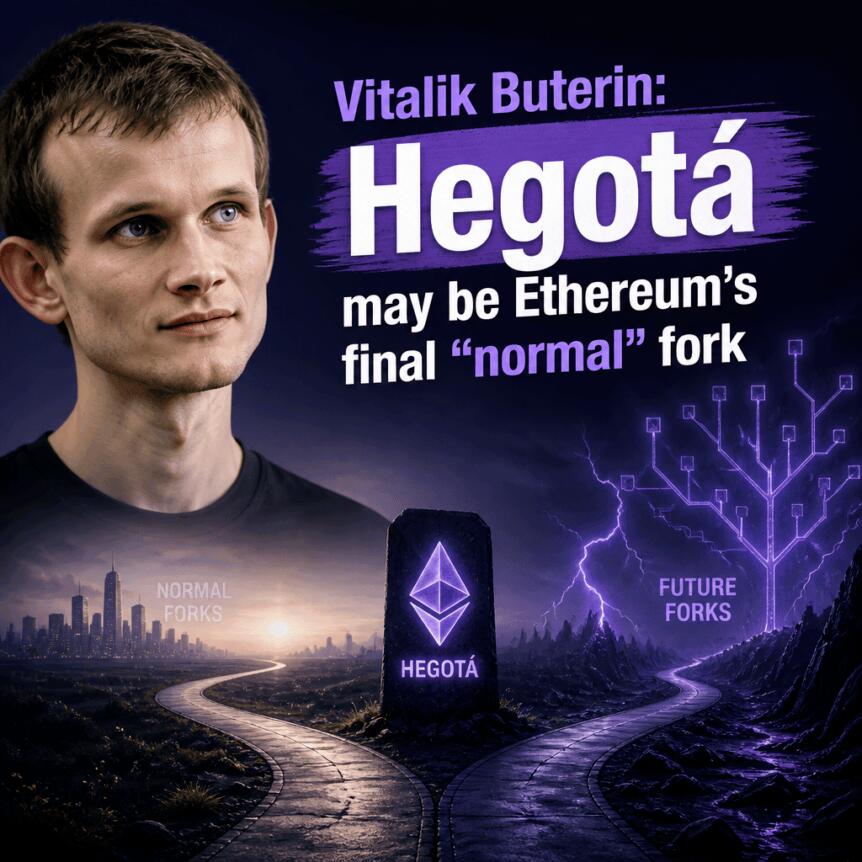
Ethereum co-founder Vitalik Buterin has suggested that the Hegotá upgrade—planned for 2027—may be the last “normal” fork in a way that will feel familiar to developers building Ethereum today. In a recent post, he framed Hegotá as a bridge toward a broader shift: Ethereum moving from a traditional blockchain that executes transactions to a “cryptographic world computer” that relies on cryptographic proofs to verify offchain computation and preserve privacy.
Buterin’s comments also pointed to earlier building blocks for this transition. He highlighted PeerDAS, which uses sampling to let nodes verify data availability without downloading everything, as the start of Ethereum’s evolution toward a system that is more than a chain of blocks.
Key takeaways
- Buterin views Hegotá (due in 2027) as likely Ethereum’s final upgrade with features that remain recognizable to builders from the network’s earlier era.
- He connects the move to “cryptographic world computer” concepts with earlier scalability work such as PeerDAS, which changes how nodes confirm data availability.
- The central design tension is what Ethereum should keep onchain versus what computation can happen offchain—while proofs bring verification back to the base layer.
- Community discussion is divided between the potential of proof-heavy architectures for DeFi and skepticism about whether real-world demand exists for continuous cryptographic verification.
Hegotá as the last “familiar” fork
In the post, Buterin said Hegotá is likely to be the final upgrade whose capabilities and underlying approach would still look understandable to someone familiar with Ethereum as it existed around 2015. That framing matters because “forks” are a developer’s mental model for incremental evolution: changes arrive in packageable upgrades, testable against known compatibility constraints and existing tooling.
By contrast, Buterin’s longer-term roadmap implies more fundamental architectural changes. He argued that future development could incorporate technologies such as recursive STARKs, automated formal verification, optimized consensus, and quantum-safe cryptography. Those ingredients suggest a system where correctness and validation increasingly depend on machine-verifiable proofs rather than on the straightforward re-execution model most users associate with blockchains.
From blockchain execution to a cryptographic world computer
Buterin described Ethereum’s trajectory as a transition from “being just a blockchain” to becoming a “cryptographic world computer.” The main idea is not simply performance improvements, but a shift in what the network is responsible for.
In his view, Ethereum would continue to provide settlement and shared state access, but it may increasingly verify results of computation that occurs elsewhere. That would move some workload offchain while keeping the base layer focused on cryptographic verification, transaction finality, and maintaining durable records needed by applications.
This matters for Ethereum application design. If more computation can be proven rather than fully executed onchain, developers could build systems that feel more like distributed infrastructure—combining onchain guarantees with offchain execution—while still ensuring users can trust the outcomes without relying on centralized intermediaries.
PeerDAS and the early signals of the shift
Buterin traced the transition back to PeerDAS, calling it the beginning of Ethereum’s move toward a more powerful platform. PeerDAS is designed to let nodes verify data availability by sampling pieces of data instead of requiring full downloads. According to Buterin, this represents a change in the underlying relationship between nodes and the data they validate.
Rather than treating verification as a brute-force process tied to complete recomputation, PeerDAS points toward verification mechanisms that can scale through smarter cryptographic and sampling techniques. If that direction continues, the broader “world computer” vision becomes more plausible: networks that verify what matters while reducing the burden of doing everything themselves.
Debate within the ecosystem: what should stay onchain?
Following Buterin’s post, Ethereum researcher Barnabé Monnot argued that offchain computation paired with onchain proofs could lower network workload and enable lighter nodes. Monnot, however, emphasized a key requirement: important records that applications depend on should still be directly onchain.
In Monnot’s framing, keeping essential information onchain lets users understand what’s happening and interact with applications without depending on external servers or middlemen. That position highlights a practical concern: even if proofs can validate correctness, reliance on offchain components can still introduce availability risks, user experience friction, and new trust assumptions unless the relevant facts remain accessible and verifiable on Ethereum itself.
Other commentators focused on how such an architecture could reshape decentralization boundaries. A pseudonymous contributor known as Cryptographic argued that proof-based verification could expand what decentralized finance can do, enabling complex logic to run outside smart contracts while Ethereum verifies protocol compliance and settles the final state.
In that context, Cryptographic cited proof-oriented examples for DeFi lending, such as performing collateral analysis, liquidation routing, or matching borrowers and lenders offchain before Ethereum verifies and finalizes results.
At the same time, skepticism remains. Crypto lawyer Gabriel Shapiro questioned how much real demand exists for proof-heavy systems compared with today’s trust-based financial services. He pointed out that many existing financial processes are built on reputation, regulation, and legal enforcement rather than continuous cryptographic verification. That critique doesn’t dispute cryptography’s technical power; it highlights an adoption asymmetry—users and institutions may not immediately replace systems whose guarantees come from courts and compliance frameworks rather than math-based verification.
Separately, the broader discussion reflects a recurring theme in Ethereum’s evolution: as the network’s capabilities move beyond simple execution, developers will need to decide how much transparency and onchain accessibility they want to guarantee—especially when computation shifts away from the chain.
As Hegotá approaches, readers should watch how Ethereum’s roadmap translates “world computer” ideas into concrete engineering milestones—particularly the balance between offchain computation, onchain proof verification, and what data remains directly accessible on the base layer. The remaining uncertainty is less about whether the concept is technically compelling, and more about how quickly the ecosystem can align developer practice, user expectations, and verification mechanisms into a system that is both scalable and practically decentralized.
This article was originally published as Vitalik Buterin: Hegotá may be Ethereum’s final “normal” fork on Crypto Breaking News – your trusted source for crypto news, Bitcoin news, and blockchain updates.
Source:
Vitalik Buterin: Hegotá may be Ethereum’s final “normal” fork

 Shoutbox
Bybit accepts Franklin Templeton... by Administrator
 Total Members: 341