Show Posts

This section allows you to view all posts made by this member. Note that you can only see posts made in areas you currently have access to.


Messages - Administrator

Pages: [1] 2 3 ... 1203
1
Hong Kong takes tokenized settlement to 24/7, plans stablecoin trials

Hong Kong takes tokenized settlement to 24/7, plans stablecoin trials

The HKMA plans to bring regulated stablecoins into tokenized government debt trials, while HSBC says its RedCoin stablecoin has reached 50,000 users.


Source: Hong Kong takes tokenized settlement to 24/7, plans stablecoin trials

2
Live updates: Binance records $6 billion outflows after starting withdrawals, less then 4% of total holdings


Source: Live updates: Binance records $6 billion outflows after starting withdrawals, less then 4% of total holdings

3
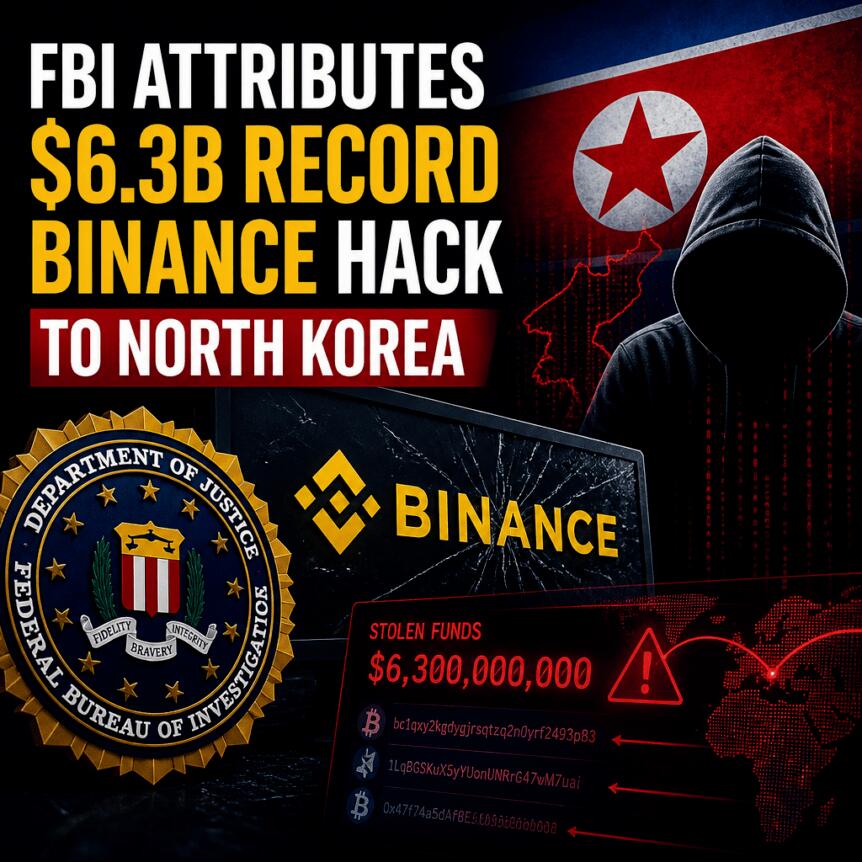
FBI Attributes $6.3B Record Binance Hack to North Korea
Fbi Attributes $6.3b Record Binance Hack To North Korea

The FBI has linked North Korea to the theft of roughly $6.3 billion in digital assets from cryptocurrency exchange Binance, according to a Saturday statement. The agency said the campaign is carried out by North Korean malicious cyber actors it labels “TraderTraitor,” a name that reflects how the group has been most recently observed moving stolen funds—largely into Ether—before progressing to further laundering stages.


In its alert, the FBI urged a wide range of private-sector participants in crypto infrastructure to disrupt the laundering workflow by blocking transactions tied to addresses associated with TraderTraitor activity. The notice also signals that investigators expect more complex movement of funds through DeFi routes and instant swap services as the stolen assets are integrated into the broader ecosystem.


Key takeaways


  • The FBI attributes the Binance theft of about $6.3 billion in digital assets to North Korea-linked cyber activity known as “TraderTraitor.”

  • Investigators say the group has recently converted stolen assets mostly into Ether, setting up follow-on laundering steps.

  • The FBI expects further conversion using DeFi protocols and instant swap services as funds advance through higher-risk stages.

  • Crypto service providers and infrastructure operators are urged to block transactions involving TraderTraitor-linked addresses listed in the FBI release.

  • Earlier reporting and research cited in the statement point to an ongoing pattern of DPRK-linked theft used to support state priorities.


FBI’s “TraderTraitor” warning and why it matters


The FBI’s alert is focused on operational disruption: it is not merely describing the intrusion, but outlining what it believes happens after funds are stolen. The agency says it has most recently observed TraderTraitor converting the assets it obtains “mostly into Ether (ETH),” suggesting that Ether is being used as a key liquidity and conversion bridge in the attackers’ process.


That matters for market participants because post-theft behavior can determine what defenders should monitor. If stolen funds are being consolidated into a liquid asset first and then redistributed, blocking or monitoring at that conversion layer can reduce the likelihood that assets quickly become difficult to trace. The FBI also expects additional movement via DeFi and instant swaps, which are often used to restructure funds rapidly and obscure transaction trails.


To counter that, the FBI urged organizations including THORNode operators, RPC node operators, instant exchanges, DeFi services, and blockchain analytics firms to prevent transactions involving addresses associated with TraderTraitor actors. The agency states that a full address list is provided in the underlying news release.


From theft to laundering: DeFi and swaps in the spotlight


The FBI’s wording underscores that laundering is expected to intensify after initial conversions. According to the statement, the attackers are moving “to more advanced laundering stages,” and the agency specifically calls out DeFi and instant swap services as likely tools used to further convert and reposition stolen value.


For investors and ecosystem builders, this highlights a recurring risk pattern: crypto theft does not end at the moment funds are stolen. The defensive challenge becomes keeping up with how quickly adversaries can adapt—especially when they can route assets through infrastructure components that may not always share a common monitoring standard.


The FBI’s call for blocking transactions tied to known addresses aims to close that gap by creating immediate friction for the attackers’ next steps. Even if attackers can search for alternate routes, preventing movement through identified endpoints can slow the process and reduce the attackers’ ability to extract value before controls take effect.


Broader context: research on North Korea’s crypto role


The Binance theft case fits into a wider set of findings referenced in the coverage. Cointelegraph earlier reported that North Korea-linked hackers accounted for about 60% of the value lost to crypto hacks in 2025, with proceeds reportedly used to support the regime’s nuclear and ballistic missile programs—an example of how digital asset theft can function as a source of hard-to-interdict financing.


Those figures align with analysis attributed in this reporting to a CertiK study. CertiK’s findings, as cited, attributed more than $2 billion of an estimated $3.4 billion in 2025 crypto security losses to groups tied to North Korea across 79 incidents out of 656 incidents documented that year.


While North Korea does not publish credible budget figures, independent research by MilitarySpend is referenced regarding defense spending capacity. MilitarySpend reportedly estimates that North Korea’s annual defense spending—based on purchasing-power-adjusted GDP estimates—could be as high as $6 billion, though the figure is described as uncertain. The analysis adds that revenue from arms transfers involving Russia, along with cryptocurrency theft, can contribute to funding for weapons programs, including development linked to WMD capabilities.


Further context cited here suggests that between 2016 and early 2026, North Korea-linked actors stole an estimated $6.75 billion in cryptocurrency across 263 documented incidents, according to CertiK and findings by onchain researcher Taylor Monahan. CertiK’s analysis is described as concluding that North Korea has “industrialized” crypto theft into a core state revenue mechanism.


What to watch after the FBI alert


With the FBI expecting stolen funds to keep moving through DeFi and instant swap services, the next critical developments are likely to center on how quickly infrastructure providers implement the address-based controls outlined in the notice—and whether attackers attempt to shift to new routes once known endpoints are blocked. Readers should also watch for additional public updates that refine the attribution set or expand the scope of targeted addresses as investigators track the next laundering steps.


This article was originally published as FBI Attributes $6.3B Record Binance Hack to North Korea on Crypto Breaking News – your trusted source for crypto news, Bitcoin news, and blockchain updates.


Source: FBI Attributes $6.3B Record Binance Hack to North Korea

4
Ethereum Price Analysis: Is $2K Next as Coinbase Premium Hits Yearly Low?

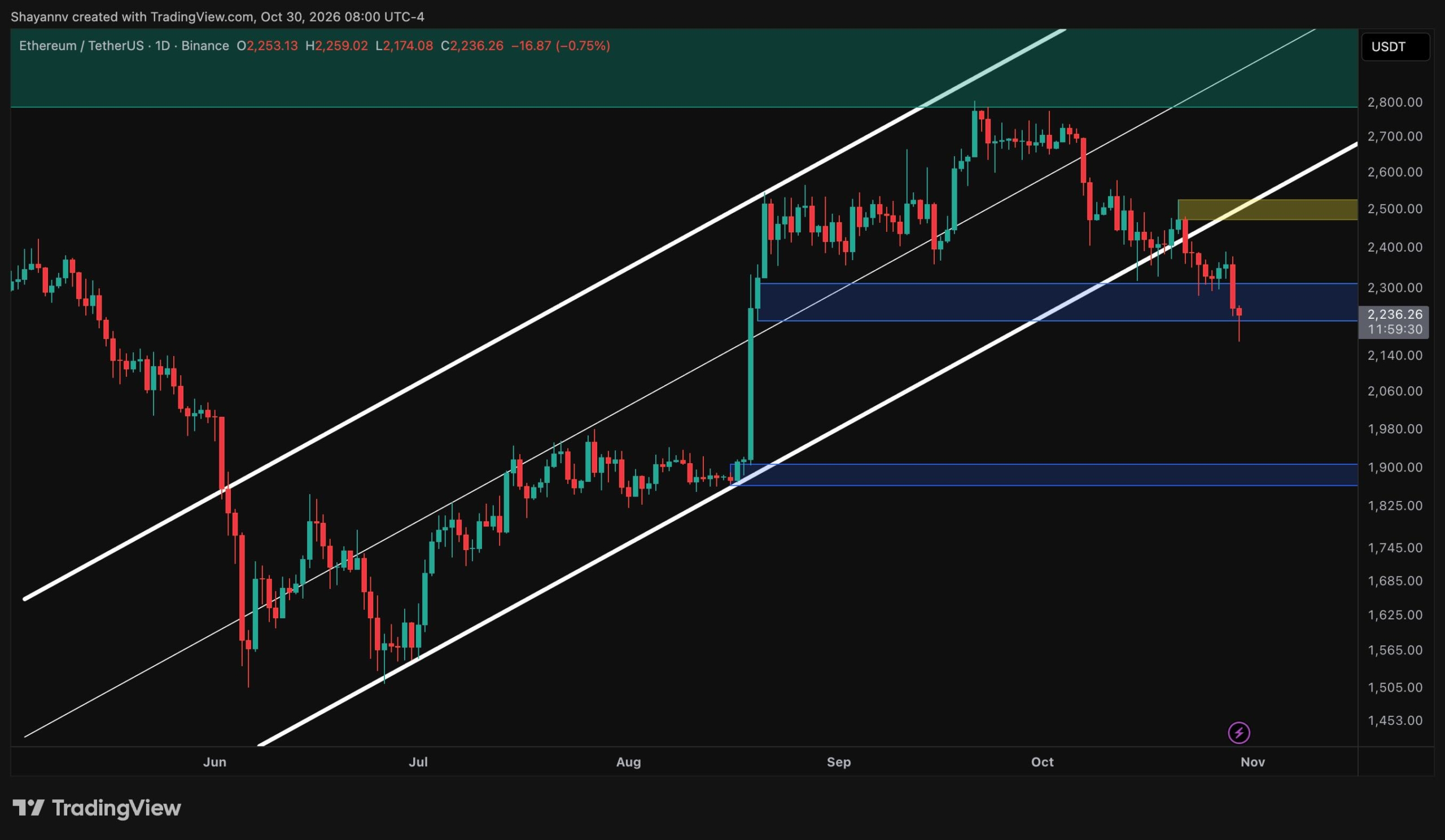
Ethereum has slipped toward $2.2K after another wave of selling extended the decline from the $2.8K highs. With ETH now trading inside a key demand zone that also aligns with the lower boundary of its short-term descending channel, the current area could decide whether the correction stabilizes or deepens toward lower support. Meanwhile, the Coinbase Premium Index has dropped to its lowest reading in over a year, pointing to notably weak demand from US investors.


Ethereum Price Analysis: The Daily Chart


Ethereum’s daily chart shows that the ascending channel that carried the price higher from the June lows near $1.5K has been broken. After rejection from the $2.8K supply zone in September, ETH fell below the channel’s lower boundary and then retested it around $2.5K, where sellers rejected the price again. This failed retest suggests the former support has turned into resistance.


The decline has now brought the asset into the $2.2K–$2.3K demand zone, which is located below the consolidation after August’s sharp rally. Today’s candle briefly wicked toward $2.15K before recovering, indicating that buyers are responding. However, the rebound remains modest, and the zone has yet to produce a convincing reaction.


If this support holds, ETH could attempt a recovery toward $2.5K. On the contrary, a valid daily close below $2.2K would expose the $1.9K order block, which is the base of the August rally and the next major demand area visible on the chart.


ETH/USDT 4-Hour Chart


The 4-hour chart shows Ethereum trading within a descending channel since early October, characterized by consistent lower highs and lower lows. The upper boundary has acted as dynamic resistance, most notably on October 21, when the price was rejected decisively from the $2.5K zone. After several days of ranging between approximately $2.3K and $2.4K, ETH broke lower aggressively.


The sell-off briefly pushed the price to the channel’s lower boundary near $2.15K, where buyers stepped in. ETH is now consolidating around $2.24K, inside the horizontal demand zone. This confluence of channel support and horizontal demand makes the current region particularly important for the short-term outlook.


A successful defense could produce a relief bounce toward the $2.4K range highs and the channel’s upper boundary near $2.42K, and a potential breakout above it would weaken the bearish structure. On the other hand, a confirmed move beneath the lower trendline would signal that sellers have regained control, leaving the $1.9K region as the next likely target.


Sentiment Analysis


The Coinbase Premium Index on CryptoQuant measures the price gap between ETH on Coinbase, a venue widely used by US investors, and Binance. Positive readings indicate stronger buying from US participants, while negative values suggest weaker demand or heavier selling on Coinbase relative to the broader market.


Throughout mid-2025, the index remained largely positive as ETH rallied toward $4.7K. Since November 2025, readings have mostly stayed negative, coinciding with the asset’s prolonged downtrend. The metric briefly turned positive in September 2026 around the $2.5K-$2.6K consolidation, but it has since collapsed to approximately -0.21, which is arguably the deepest reading in the visible period, alongside the latest drop toward $2.2K.


This suggests US demand has weakened sharply. Notably, a similarly extreme reading in February 2026 occurred close to a local low, so the current figure could also reflect capitulation rather than sustained selling. Either way, the index would need to recover alongside price for ETH to defend the $2.2K support and challenge the $2.5K resistance. Otherwise, the excess supply and weak technicals could bring ETH back below $2K soon.


The post Ethereum Price Analysis: Is $2K Next as Coinbase Premium Hits Yearly Low? appeared first on CryptoPotato.


Source: Ethereum Price Analysis: Is $2K Next as Coinbase Premium Hits Yearly Low?

5
BTC heads into US midterm showdown: Three things to know in Bitcoin this week

BTC heads into US midterm showdown: Three things to know in Bitcoin this week

Bitcoin price action held its 100-day moving average into the monthly close as crypto markets braced for US midterm election and tech earnings volatility.


Source: BTC heads into US midterm showdown: Three things to know in Bitcoin this week

6
China’s Communist Party calls for a crackdown on corruption that uses crypto and blockchain


Source: China’s Communist Party calls for a crackdown on corruption that uses crypto and blockchain

7
OKX draws $445M in net inflows as Binance outflows exceed $7B

OKX draws $445M in net inflows as Binance outflows exceed $7B

OKX led cryptocurrency exchanges with $445 million in daily inflows, while Binance processed about $7 billion in net outflows.


Source: OKX draws $445M in net inflows as Binance outflows exceed $7B

8
Why stealing billions from a crypto exchange can be harder to stop than a bank theft


Source: Why stealing billions from a crypto exchange can be harder to stop than a bank theft

9
Bitcoin ETFs sink into October outflows with $643M exit after Binance hack

Bitcoin ETFs sink into October outflows with $643M exit after Binance hack

US spot Bitcoin ETFs ended October with $515 million in net withdrawals, while Ether funds posted a record $1.61 billion in monthly outflows.


Source: Bitcoin ETFs sink into October outflows with $643M exit after Binance hack

10
Bitcoin ETFs lost $643 million in outflows Friday, and 2026 is barely green now


Source: Bitcoin ETFs lost $643 million in outflows Friday, and 2026 is barely green now

11
Strangers are begging the Binance hacker for bitcoin, one ‘help me bro’ at a time


Source: Strangers are begging the Binance hacker for bitcoin, one ‘help me bro’ at a time

12
BTCPay Server warns of hot wallet thefts running on outdated software

BTCPay Server warns of hot wallet thefts running on outdated software

BTCPay Server urged operators to shut down their servers after receiving reports of unauthorized attackers draining funds from hot wallets.


Source: BTCPay Server warns of hot wallet thefts running on outdated software

13
Bitcoin claws back toward $79,000 as markets shake off crypto's biggest hack


Source: Bitcoin claws back toward $79,000 as markets shake off crypto's biggest hack

14
THORChain founder rejects freeze request, CZ thanks Secret Service: Hodler’s Digest

THORChain founder rejects freeze request, CZ thanks Secret Service: Hodler’s Digest

Binance has reopened withdrawals following the world’s biggest ever hack, and THORChain co-founder argues it should not halt the protocol to comply with FBI demands.


Source: THORChain founder rejects freeze request, CZ thanks Secret Service: Hodler’s Digest

15
BTCPay, a bitcoin payment tool, tells users to switch off their servers after reports of drained wallets


Source: BTCPay, a bitcoin payment tool, tells users to switch off their servers after reports of drained wallets

Pages: [1] 2 3 ... 1203