Post by: Administrator on September 25, 2026, 06:46:31 PM
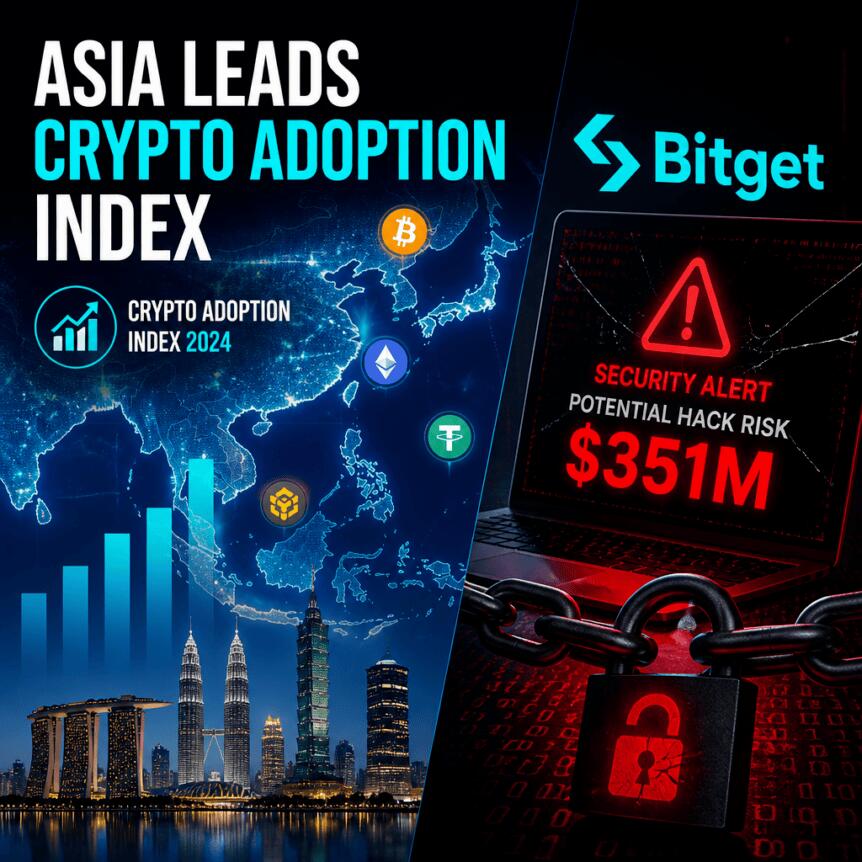
Asia’s grassroots crypto footprint remains a dominant force in the global market, according to Chainalysis’s latest 2026 Global Crypto Adoption Index. Among the 20 countries ranked for broad, on-the-ground adoption, nine are in Asia Pacific—accounting for “almost half” of the top tier.
The index also points to a notable shift in how stablecoins are being used across borders, while other parts of the region continue to grapple with exchange security, evolving financial infrastructure, and regulators testing settlement rails.
Key takeaways
- Japan, South Korea, India, Thailand, and several other APAC countries rank in the top 20 of Chainalysis’s 2026 grassroots adoption index.
- Cross-border stablecoin transfers are singled out as a key growth area in Asia, reflecting demand for faster settlement across fragmented payment systems.
- Bitget confirmed an unauthorized incident affecting about $351.6 million and paused withdrawals while investigating.
- Binance invested $100 million in Circle as part of an expanded five-year USDC partnership agreement.
- Several jurisdictions in the region are moving toward longer operating hours and new infrastructure models for settlement and tokenized finance.
APAC’s heavy weight in grassroots crypto adoption
Chainalysis reports that nine of the top 20 countries for grassroots crypto adoption are located in Asia Pacific. The ranking places Japan at #4, followed by South Korea (#5), India (#6), Thailand (#8), China (#12), Indonesia (#14), Australia (#15), Vietnam (#18), and the Philippines (#19).
The broader theme is that adoption in the region is not limited to trading activity—it extends into day-to-day behavior and payment experimentation. Chainalysis’s index frames this as “grassroots” activity, which typically emphasizes how real-world users interact with crypto rather than purely institutional flows.
Stablecoins gain traction for cross-border payments
One of the clearest operational trends highlighted for the APAC region is the rise in cross-border stablecoin transfers. Earlier coverage from Cointelegraph noted stablecoin cross-border flows increasing significantly—standing out even during broader market softness.
Cointelegraph also reported remarks from Tianwei Liu, co-founder and CEO of StraitsX, who argued that stablecoin demand in Asia has been shaped by fragmented currencies and payment systems. In his view, stablecoins are increasingly used as settlement rails—often because they can fit into payment workflows that people already rely on.
“That demand is also extending into everyday spending, with stablecoins sitting behind payment methods people already use,” Liu said.
For investors and builders, the implication is straightforward: stablecoins are starting to function less like a “side bet” on crypto markets and more like a payments primitive where speed and cross-border usability matter. The key question is whether this momentum concentrates around a small number of issuers and networks—or spreads as more payment providers integrate stablecoin rails.
Exchange security: Bitget confirms $351.6M breach and suspends withdrawals
While adoption narratives build, crypto infrastructure continues to face high-profile security tests. Cointelegraph reported that Bitget confirmed an unauthorized transfer affecting approximately $351.6 million in assets and temporarily suspended withdrawals during its investigation.
Cointelegraph also cited the exchange CEO Gracy Chen, who said the breach was contained to a portion of Bitget’s hot and warm wallet layers, while its cold wallets remained secure. Bitget said it flagged addresses associated with the transfers and contacted law enforcement and on-chain security firms.
The exchange added that the affected amount falls within its User Protection Fund, which currently holds more than $464 million.
This kind of incident matters for users even when funds are insulated, because withdrawal suspensions directly affect liquidity and confidence. It also raises the market question of how quickly major platforms can restore normal operations—and whether security reviews result in changes to custody and transaction routing beyond the specific hot-wallet layer involved.
USDC partnership expands as Binance invests $100M in Circle
On the stablecoin issuance side, Binance moved to deepen its commercial relationship with Circle. Cointelegraph reported that Binance invested $100 million in Circle as part of an expanded five-year agreement aimed at promoting USDC on Binance.
Under the expanded deal, Circle is set to pay Binance a monthly incentive fee that is based on the amount of USDC held through Circle’s Modular Smart Contract Wallet infrastructure. Binance also agreed to take on additional activities to promote USDC on its platform.
For market participants, these terms reinforce an important dynamic: stablecoin distribution increasingly depends on large exchange partnerships that can provide both liquidity and integration depth. The more such incentives align with balance growth on a platform, the more issuers and exchanges may have shared incentives around stablecoin usage—not only trading but on-platform settlement and user onboarding.
Regulatory and infrastructure experiments across Asia
Beyond exchanges and stablecoins, the region continues to test new models for financial infrastructure and settlement timelines.
In South Korea, Cointelegraph reported that the Bank of Korea (BOK) launched a pilot for a 24-hour won settlement network designed to allow foreign investors to settle won transactions outside normal South Korean banking hours. Trial operations began with four domestic lenders, with full operations planned for January 2027 and broader participation expected afterward.
In Hong Kong, the Hong Kong Monetary Authority (HKMA) outlined plans to upgrade its Central Moneymarkets Unit debt securities settlement system to run on blockchain 24/7, with the upgraded platform intended to handle CBDCs, tokenized deposits, and stablecoins.
Other developments underscored the diversity of how tokenization is being considered—from bond settlement pilots using blockchain-based allocation and payment settlement, to partnerships between payment companies and infrastructure providers to explore stablecoin opportunities.
Corporate, policy, and security signals from the wider region
Several non-market signals also shaped the regional story. In Hong Kong, Animoca Brands suspended plans for a Nasdaq reverse merger involving Nasdaq-listed Currenc Group, citing review of market conditions and deal timeline projections, while leaving room to restart talks if conditions improve.
In Saudi Arabia and China, reporting highlighted that Saudi Arabia withdrew from the China-backed mBridge CBDC project after completing a proof of concept, ending its participation following that milestone.
And across the region’s cybersecurity landscape, reporting said a North Korean cyber group targeted developers with fake job offers, infecting at least 30,000 devices across more than 100 countries and stealing cryptocurrency worth about $10.7 million.
Going forward, the most closely watched variables will likely be whether stablecoin usage continues to expand in everyday and cross-border workflows, and how quickly major platforms can convert security incidents into durable operational changes. On the policy side, developments in 24/7 settlement and blockchain-enabled financial infrastructure will be a useful barometer for how fast tokenization ideas move from pilots to mainstream operations.
This article was originally published as Asia Leads Crypto Adoption Index as Bitget Faces $351M Hack Risk on Crypto Breaking News – your trusted source for crypto news, Bitcoin news, and blockchain updates.
Source: Asia Leads Crypto Adoption Index as Bitget Faces $351M Hack Risk (https://www.cryptobreaking.com/asia-leads-crypto-adoption-index/)