Post by: Administrator on August 18, 2026, 10:52:27 PM
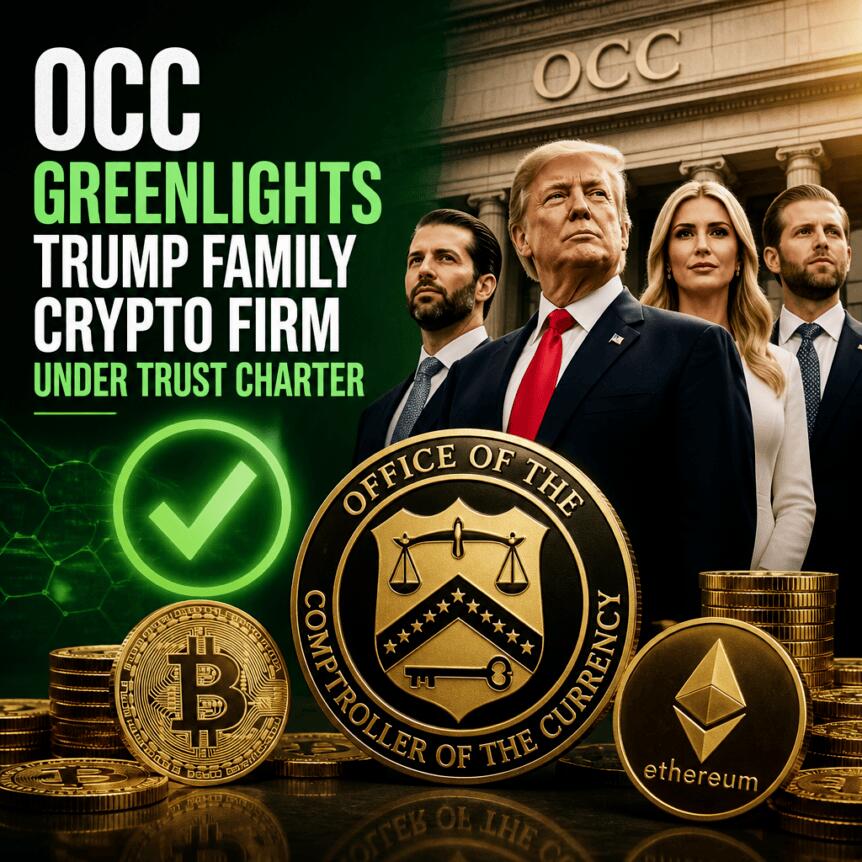
The US Office of the Comptroller of the Currency (OCC) has granted World Liberty Financial conditional approval to operate as a national trust bank, a decision that immediately reignited political scrutiny over potential conflicts of interest involving President Donald Trump and members of his family.
In a Friday notice, the OCC said its conditional approval for World Liberty’s charter application would permit the company to proceed as “World Liberty Trust Company, National Association,” subject to regulatory and policy requirements. World Liberty’s filing indicates the bank would support US dollar-backed stablecoin issuance and would custody digital assets related to its USD1 token.
Key takeaways
- The OCC’s approval is conditional, allowing World Liberty to move forward as a national trust bank only under specified requirements outlined by regulators.
- World Liberty’s charter application contemplates issuing US dollar-backed stablecoins and providing custody for digital assets linked to its USD1 token.
- Criticism from US lawmakers centers on possible conflicts of interest tied to Trump family involvement and the OCC leadership appointment.
- Sen. Elizabeth Warren announced new legislation aimed at addressing what she described as “presidential corruption” in banking following the OCC’s action.
- The decision arrives amid a broader pattern of OCC approvals and conditional approvals for crypto firms seeking trust charters.
What the OCC approved—and what it still requires
The OCC’s Friday notice frames the action as consistent with statutory duties and ethical obligations. The regulator’s conditional approval means World Liberty may be able to operate under the proposed name—World Liberty Trust Company, National Association—but must satisfy the conditions attached by the OCC before fully realizing its intended banking activities.
According to World Liberty’s application, the planned business includes issuing stablecoins backed by US dollars and custodying digital assets connected to the company’s USD1 token. For investors and users watching the intersection of crypto rails and traditional finance, the significance lies in what a national trust bank framework can enable: a regulated structure for custody and, potentially, issuance-linked services, depending on how requirements are ultimately met.
Conflict-of-interest concerns drive the political backlash
Opposition to the approval is rooted in allegations that regulators and the White House could be subject to improper influence. The OCC’s action comes as lawmakers have pressed questions about relationships between World Liberty and the Trump family.
The OCC approval followed heightened scrutiny about potential conflicts of interest between the company and President Trump’s family. The president and three sons are described as affiliated with World Liberty. The head of the OCC, Jonathan Gould, was also nominated by Trump in 2025. Separately, World Liberty’s website has indicated that a Trump family entity controls 38% of the company’s equity interests.
While the OCC stated that it acted in line with its ethical obligations, the political dispute escalated immediately after the announcement. Sen. Elizabeth Warren said she had introduced legislation “to stop this kind of unprecedented corruption,” calling the OCC’s move “the most brazen act of self-dealing our financial system has ever seen.” Warren and nine other senators introduced the “Ending Presidential Corruption in Banking Act” following the approval.
Warren’s comments and the filing of new legislation underscore a key uncertainty investors should track: the OCC may have issued conditional approval, but Congress could still push for legal and oversight changes that affect how—or whether—such bank charters are granted or operated when political relationships are at issue.
Gould said review would be apolitical earlier
Prior to Friday’s decision, Gould had indicated the charter review would be conducted through an “apolitical and nonpartisan process.” Earlier coverage from Cointelegraph noted that Gould made this point while referencing the review process after correspondence from Sen. Elizabeth Warren.
In the Friday notice, the OCC emphasized that its “Comptroller and staff acted consistently with their statutory duties and ethical obligations with respect to the Application.” The regulator’s language suggests it believes the same standards applied regardless of the controversy—an important distinction for market participants assessing regulatory risk.
Still, the rapid pivot to legislative action suggests the dispute is not confined to regulatory conditions. The coming months will likely determine whether Congress focuses on reinforcing ethical firewalls for bank licensing in crypto-adjacent businesses, particularly where political ties are alleged.
World Liberty’s wider ecosystem ties remain under investigation
Beyond US regulatory concerns, the approval also reopened questions about World Liberty’s relationships with foreign entities. According to earlier reporting, an Abu Dhabi investment company backed by UAE national security adviser Sheikh Tahnoon bin Zayed Al Nahyan reportedly purchased a 49% stake in World Liberty in January 2025 for $500 million. Another UAE entity, MGX, used World Liberty’s USD1 stablecoin to invest $2 billion in crypto exchange Binance. The same reporting notes that Trump later issued a presidential pardon for former Binance CEO Changpeng Zhao.
A White House spokesperson has repeatedly said there were “no conflicts of interest“ with Trump’s investments, a position that lawmakers challenging the charter approval say does not address broader governance and transparency concerns.
The continued attention matters because national trust banking is tightly linked to trust, custody standards, and compliance. If lawmakers pursue investigations or new rules affecting how these relationships are disclosed or managed, the operational path for World Liberty’s stablecoin and custody plans could change.
How this fits into the OCC’s broader crypto charter push
The OCC’s conditional approval also reflects an ongoing trend under the Trump administration: approving or conditionally approving multiple applications from crypto companies seeking trust charters to expand their services in the US.
In December, the OCC approved applications from Circle, Ripple Labs, Crypto.com and Coinbase after passage of the GENIUS stablecoin bill in Congress, according to earlier coverage from Cointelegraph. That earlier wave of approvals sets a reference point for how the OCC has been moving toward regulated stablecoin and related services.
World Liberty’s case adds a new layer to that pattern because the controversy is not only about crypto compliance and licensing. It is also about the governance question of who benefits, who influences, and how regulators insulate decisions from political entanglement.
For readers, the next thing to watch is how the OCC’s conditions are spelled out and implemented for World Liberty’s charter to fully take effect, alongside whether Congress’s “Ending Presidential Corruption in Banking Act” gains traction that could reshape licensing standards for bank charters tied to politically connected firms.
This article was originally published as OCC Greenlights Trump Family Crypto Firm Under Trust Charter on Crypto Breaking News – your trusted source for crypto news, Bitcoin news, and blockchain updates.
Source: OCC Greenlights Trump Family Crypto Firm Under Trust Charter (https://www.cryptobreaking.com/occ-greenlights-trump-family-crypto/)